Quick Answer
An AI tool stack planner maps each AI tool you use against core business functions like writing, image generation, and SEO, showing which functions are covered, which have redundant overlapping tools, and which have no AI support at all. Someone using ChatGPT for writing and Midjourney for images but nothing for SEO or automation would see two functions covered and eight gaps out of ten.
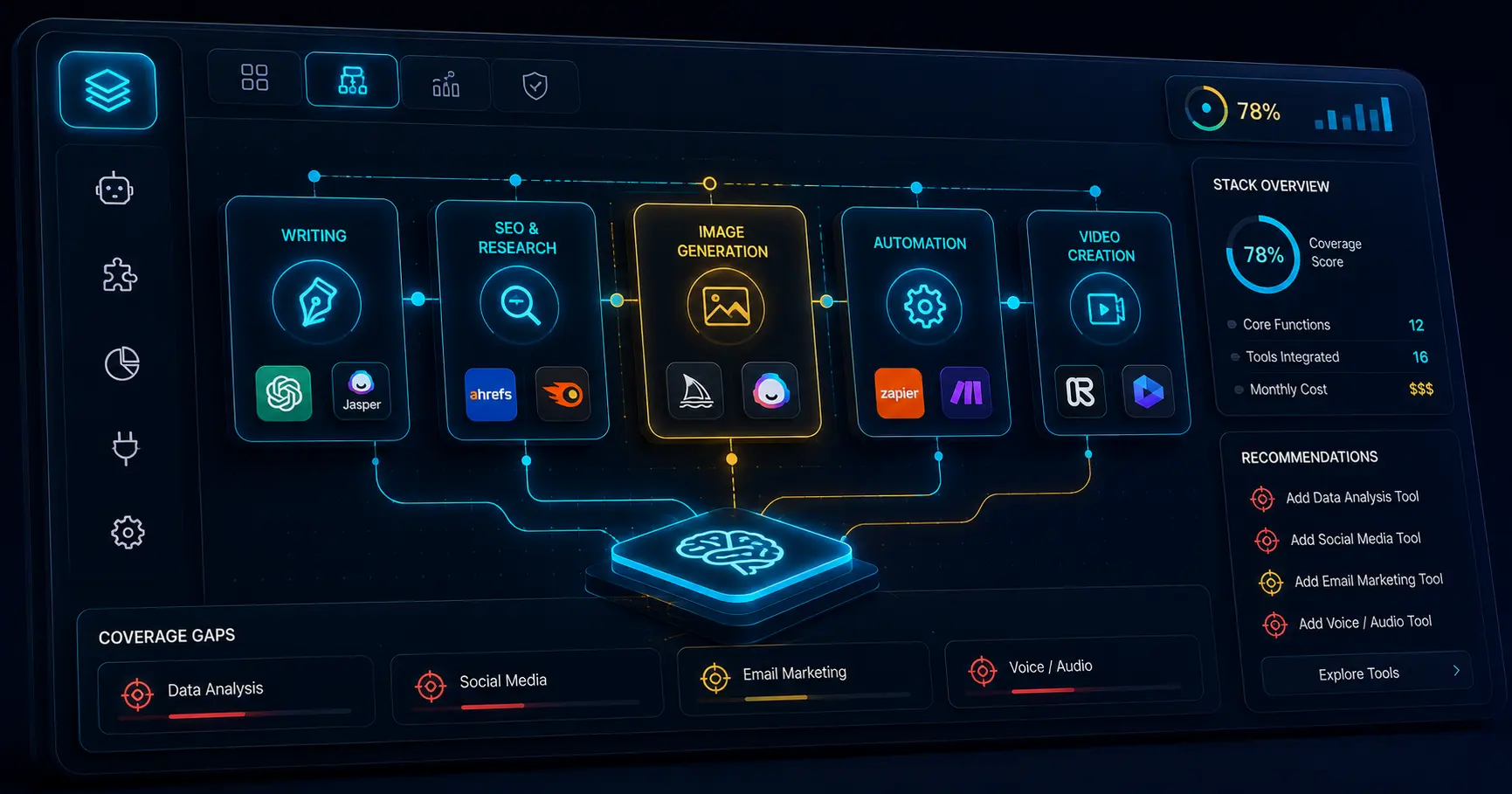
How the AI Tool Stack Planner Works
Add each AI tool you use, assign it to the function it serves — Writing & Content, Image Generation, SEO & Research, and so on — and optionally enter its monthly cost. The planner checks your tools against 10 core functions common to content and affiliate marketing businesses, then shows a Function Coverage breakdown: a green check for functions you’ve covered, a gold flag for functions with more than one tool assigned (potential overlap), and a gray “Gap” label for functions with no tool at all.
This is a different question than the AI Subscription Cost Calculator answers. That tool tells you what you’re spending; this one tells you whether that spending is actually covering what your business needs — or piling up in a few categories while others go untouched.
Reading Overlap vs. Gaps
Overlap isn’t automatically bad — some functions genuinely benefit from two tools with different strengths, like one AI writer for long-form and another for short social captions. But overlap is worth a second look when both tools do essentially the same job. Gaps are more straightforward: a function with zero tools is either genuinely not needed for your business, or a real opportunity being left on the table.
Coverage (%) = (Functions With At Least 1 Tool ÷ 10) × 100
Overlap = Number of Functions With More Than 1 Tool Assigned
Tips for Using This Planner Effectively
- Be honest about “not needed.” Not every business needs all 10 functions covered — a text-only blog may have no real use for Video Creation tools, and that’s a legitimate gap to leave open.
- Check overlap before adding new tools. If you’re about to sign up for a new AI writing tool, check whether Writing & Content already shows an overlap first.
- Revisit quarterly. Tool stacks drift over time as new tools launch and old ones get forgotten — a periodic re-check keeps the map accurate.
- Use gaps to guide research. Once you’ve spotted a real gap, browse our AI Tools Directory for reviewed options in that specific category rather than searching blind.
Example Scenarios
ChatGPT for writing, SurferSEO for research, Canva for graphics — three functions well covered, seven gaps that may or may not matter depending on the business.
Three different AI writing tools all doing similar work — the planner flags Writing & Content as an overlap, prompting a review of whether all three are needed.
Zapier, Make, and a chatbot tool covering Automation and Customer Support heavily, but no coverage at all for Image Generation or Video — a deliberate, focused stack.
One tool assigned per function across eight of the ten categories — a genuinely broad stack that the planner rates as well-rounded with minimal overlap.
Frequently Asked Questions
Do I need to cover all 10 functions?
No — the 10 categories represent common functions across content and affiliate marketing businesses, not a requirement. A blog-only business may have no real need for Video Creation or Coding & Development tools, and that’s a legitimate, intentional gap rather than a problem.
Is having multiple tools in one category always bad?
Not necessarily. Some functions benefit from specialized tools working alongside each other, like a dedicated image generator plus a separate background-removal tool. The overlap flag is meant to prompt a review, not a rule that says one tool per category is always correct.
How is the coverage score calculated?
Coverage is the percentage of the 10 core functions that have at least one tool assigned. Assigning a tool to a function marks it covered regardless of how many tools are in that category — overlap is tracked and shown separately.
Can I add my own custom function categories?
The planner currently uses a fixed set of 10 common categories to keep the coverage score consistent and comparable. If your business uses AI in a way that doesn’t fit any category well, choose the closest match — the tool list and monthly cost will still be tracked accurately either way.